
From Remi in Montreal
Yesterday a terrific comment by Canadian National Team skater Rene L’oiseaux appeared on my post “cats & short track”. As few would likely notice this on this older post, I asked Rene if I could repost it here, as it contains some essential truths about training for ALL types of skating, not just his specialty of short track (I especially liked points 3 & 4). I asked him to send me a pic of him skating, and wow, did he ever send me a picture!!!
Here he is, leading Jeffrey Sholten sometime last winter:
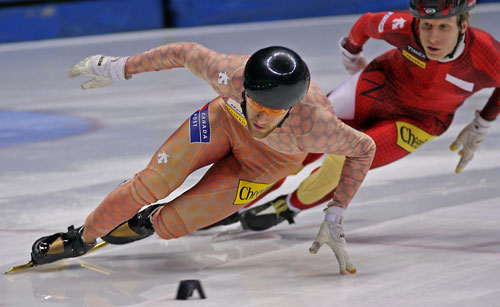
And here is his post:
Hi everyone, I’m a short track speed skater for the Canadian National team. I have been skating for the last 15 years. First of all i’m always glad to see people discussing and showing their love and interests for this Ho! so crazy sport.
For sure I agree with the fact that short track doesn’t get enough coverage and recognition. From what I read and hear when I talk to people it seems that the main issue and the reason why is the simple fact that nobody can really have a good idea of how hard and complicated this sport can be.
As this - pretty much new sport - grow older, you need to have lots of qualities
- You need strategy: to do clean passes, to be sharp for the last laps,
- You need technology: good blades so you are able to turn and glide, good boots to have better support, blades are set differently for each skaters and for each type of ice (ex. hard or soft) as in Formula 1.
- Incredible fitness: so you can be as efficient as possible for the entire race
- Perfect techniques: that will help you glide, turn without losing speed, do better passes, reach higher speed…
- and all of the above interact with each other and that is what make skaters better than other.
keep on skating
Remi
Remi (he seems to sign his name both Remi and Rene) is a French Canadian living and training at their national training center in Montreal. Did you know that Montreal alone has more skaters than the ENTIRE MEMBERSHIP of US speedskating? He is a fast fish in one tough pond.
He is aware of what is going on in US speedskating right now and wants to start a dialogue here between Canadian and American skaters, so we can learn best practices from each other.
I think it’s a great idea, as there are fundamental differences between our organizational systems. I will kick off the discussion with several observations others have told me:
A top US Coach said some Canadians have told him Canada does an outstanding job developing good skaters from their huge grassroots programs, but they think the Americans do a better job at taking exceptional talents and turning them into gold medal winners.
Someone with dual-Canadian US citizenship once ruminated to me that he thought that there were cultural differences in attitudes of risk, Americans tend to be more aggressive in trying to win or crash trying, he thought many Canadians would rather be a surefooted top ten.
Canada has astonishingly well developed & comprehensive athlete programs in both Montreal and Calgary, what lessons can Salt Lake, Milwaulkee, and Marquette learn from them?
I grew up a 3 hour drive from the Canadian border, but only as an adult have I began to appreciate the fascinating variety of cultural differences, things that reach far deeper than mistaking a Tim Horton’s for Dunkin Doughnuts of the north (their coffee & boston cremes are better). Canada is it’s own thing, and the closer I have looked, the more I appreciate it’s individuality. Even in things that are seemingly simple like speedskating, there are a million ways to approach it.
Oh, and speaking of Canada, it’s worth saying: Peter Doucet is one of my favorite brothers O’ the wheel & blade on the planet. It’s been too long since I have seen that redhead sparkplug of skating soul!! Shouts go out to all my ‘ol toronto inline speed team buddies!!
Lots to think about here. What do readers here think? after the recent Olympi-gasm, it’s the proper time to think and ruminate. As I write this (in Cocoa cafe in downtown salt lake), national team coach Tom Cushman walked by, stopped & we chatted a bit about these subjects, the 4-year cycle of change is on many people’s mind.
Filed under: from the coffee shop




The thing about cultural differences reminds me of an old post you wrote on places of the heart.
People are highly variable.
Cultures are shaped by the majority.
Therefore, there have to be a lot of people for whom the culture they’re in, even the one they grew up in, is not the best fit for their souls.
Would you be a better skater if you trained as a Canadian? Would there be a better fit to your talents, quirks, and motivators in Holland? Maybe, maybe not.
The culture of Hawai’i seems to suit my soul a lot better than that of New York, where I’ve lived - generally happily - for 30 years. (We won’t even discuss Baltimore, where I grew up.)
I suspect most people never question this. (Actually, I’m convinced that most people never question anything and are largely asleep.) For most of history, only a very few people ever had the opportunity to encounter a culture outside their native one. Now, many of us can theoretically explore and choose consciously, but I don’t see people doing it. I almost sense an attitude of disapproval to same in the American popular culture (as I know it, which isn’t very broadly or deeply) - what, the way we live isn’t good enough for you? What has Japan/Southern France/New Zealand…. got that we don’t have?
Wrapping back around, i think that sport in any country has to be deeply connected to the Zeitgeist. Sport, even for those who only watch it, is emotional, cultural. It’s not just that Brazilians care about soccer and Americans generally don’t; it’s lots of beliefs and attitudes that will necessarily permeate the culture and all its activities.
Not to pick on Brazil today, but I remember reading years ago that they didn’t develop winning swimmers, in the author’s opinion because they recorded wins but not personal bests. That, he thought, discouraged a lot of kids and kept the sport small. In the US it’s the other way around; huge numbers of fourth-graders swim competitively.
Perhaps if all you skaters put your minds to analyzing the different training programs and skating cultures around the world, you could see which one was the best match for each of you. It might be nice to approach “one world” closely enough to make it easy to join that best environment - but not so completely that the differences begin to be homogenized.
Andrew
Your blog today about Remi and Canadian Speedskaters reminded me of how great it was to meet Jeremy wotherspoon and Cindy Klassen back in the november World Cup Meet here, and the other Canadian speedskaters. It is not a ‘minor, forgotten sport’ in Canada! Canada has far less of a population base than the U.S., and far less money to invest in Olympic Development programs, yet commesurately they have better results, I think.
That is probably due to the relative status of skating sports in Canada, along with their excellent ‘grassroots’ programs, which I’ve heard their skaters praise.
Sadly, I’ve never heard any of our skaters praise the U.S.Speedsakting-org.-individual coaches, yes, but we as an ‘org’ could stand to learn from the canadians, i.m.o.
Greg
One thing I think is important to point out about the Canadian skating programs, and from what I understang, MANY sports in Canada, is that they have monetary support from the government. They also, as others have pointed out, come from a TOTALLY different culture. In my experience, all the Canadians I have ever met have been very accepting of ANYONE trying to help, instead of what many people in the US have experienced, “no outsiders welcomed”.
In my opinion, Canadians, as a whole, are much more relaxed people. The ones I’ve met also DON’T carry the typical arrogant American attitude, which I’m sure takes them farther in most things they do. Sorry Americans.
I think culture may be at some point one the the reasons why this and why that. On the other hand, it may be far from the first fact US org. may look at the make sure they go on with the good track.
From what I think, one of the first point would be the whole Training center thing. It would be, especially for short track, a very good thing to start skating as a team. As a whole big team. Stop working for only 1 or 2 persons. If you take 10 woman and 10 guys, they can start working with each other. This would provide a better environnement where they can talk about skating and learn from eachother. Also, it helps a lot to develop young skaters so they can skate with teammate and improve faster then on their own.
In US, athletes have the chance to have HUGE training center where every athletes can focus only on their performances. They got everything they need to imporve. The US org may take more advantage of those great sport structures.
As for the money, remember that in canada speed skating wins a lot of medals at the olympics for the country and, as the next one are in Vancouver, it helps a lot to get money. Also they pay for school so it is definetly a nice thing to help athletes. Still, I don’t understand how USA manage to don’t get money for speed skating ’cause from what we ear up north, USA is always the place to be to make money. (??)
Remi said, “Stop working for only 1 or 2 persons. If you take 10 woman and 10 guys, they can start working with each other. This would provide a better environnement where they can talk about skating and learn from eachother.”
You are RIGHT ON with this. I can’t tell you how many times I’ve heard this complaint from skaters.
It was also announced today that ST National Team Coach, Li Yan has resigned. We can only hope someone qualified and willing to work with the “TEAM” is hired.
hey, Steph! I tried to ‘answer’ your [comment?]on the new USSpeedskating ‘myspace’ Site, but I’m an idiot over there, not sure how to ‘drive’ my way around that website format! did you get my post? [i posted this here as a little hint to folks to go check it out if they haven’t, hope that’s ok, andrew!]
no problem greg, the web is ALL ABOUT LINKS, the more the merrier…
facinating discussion today, thanks go to remi, who emailed me in the first place, and in his email, got me thinking about this…
I’ll second that… Thanks Remi.
Greg, you’ll learn it. It’s really easy once you use it more. But, I have no idea what comment you’re talking about. Sorry. hahaha
Hi All,
I’d like to say something from the long track skater’s perspective. I really admire the Canadian women’s long track team. Since the time I came back to the sport in 2001, I have seen them improve so much, and I think that is because they have worked together as a team.
I also believe that here in the USA, we have the talent to do the same thing, but we haven’t been able to get the women to work together. One problem is because the “USS people” haven’t tried to make this happen, and another is because of certain skaters who didn’t want to skate with certain other skaters.
I’d also like to thank Remi for bringing up the issue of training centers, because I think that it’s very important to provide these for athletes. I still can’t believe we don’t have a training center for athletes here in Salt Lake City!!! I’m so afraid that the Utah Olympic Oval is going to die, and one of the main reasons is that there is no place for athletes to stay when they come here to train, whether it be American skaters or foreign teams coming for training camps.
I’d also like to address the question of why it’s so hard to find money for speedskating in the USA. I think that with the proper marketing strategy, it would be no problem to find good enough team sponsorship for US Speedskating to take care of everything the skaters need.
However, several of USS’s sponsorships have been found “through a friend of a friend,” not by trying to sell the team. The biggest problem has been USS’s unwillingness to work with real marketing professionals who had the ability to find good sponsorships. For example, one guy they had working for them found some great sponsorships before 2002, but because some of the USS administrators were offended because he was “making so much money,” they let him go.
How stupid is that? It only stands to reason that if someone finds USS a lot of money, then the percentage he makes for himself will also increase!
I’m hoping that with a new Executive Director, this attitude will go away forever. Just let the marketing person do their job!
Well said, Eva. I think you are a making a HUGE difference, and for that, you should be VERY proud.
these discussions are good, in that most of us in this discussion know these issues, others can learn about them and perhaps make their voices heard, too.
by constantly expressing our opinions in forums and blogs,and getting others involved in said discussions, we do change things. I think we saw some of the positive changes starting at the board meeting, and the immediate ‘fallout’.
ignorance and indifference are the enemy of democracy, and the democratic funcioning of any american org, including USS.
thanks, Remy, that’s inspiring to learn more about how you canucks do it.
Greg
And then there was one… Shimabukuro.
I want to thank all of you who went to the board meeting and voiced your opinions. I think it did a world of good. You were obviously heard… loud and clear.
My son Nolan started speedskating this year and loves it. Is there a camp he can come to in Montreal this summer for some lessons. You
would you recommend. Please e-mail me some information.
Susan
My son Nolan started speedskating this year and loves it. Is there a camp he can come to in Montreal this summer for some lessons. You
would you recommend. Please e-mail me some information.
Susan