
Wildfires
Here is a wonderful idea of the modern age: a pulloff near the airport, where you can sit in your car waiting for your cellphone to ring, watching a billboard with live updated flight info.
The sunset was a nice bonus.
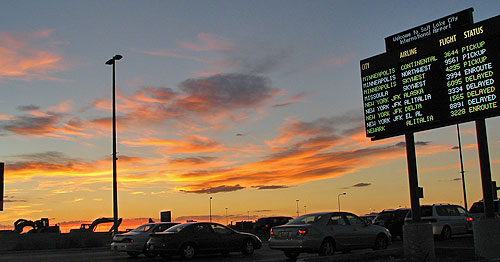
I was there to pick up my wife from her long trip back east. As we were driving home, she mentioned that she had seen several huge wildfires from the plane, one throwing a massive plume of smoke far into the stratosphere.
Then she said; “I think I saw something burning in the mountains over Salt Lake.” Sure enough, as we pulled out of the airport we saw a massive circle of flames throbbing in the face of the Wasatch.
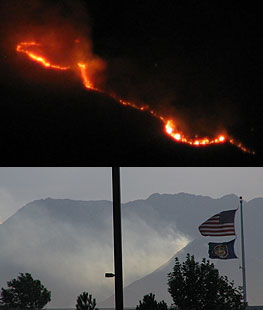 I took this picture from near our house, this burning line is probably about a mile long. Here is the local news report. A skater who lives in that neighborhood saw an army of firefighters, hoses at the ready, waiting to unleash a point blank shot of H2O fury. But the wind driven fire marched up the hill, not down towards town.
There was still smoke rising the next morning.
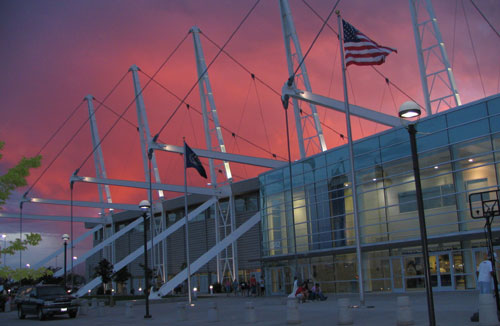
Like volcanos and nuclear blasts, wildfires add particulate matter into the atmosphere, and make spectacular sunsets. The next day after the blaze, this was the evening sky above the Utah Olympic oval (I did not touch these colors with photoshop at all).
I took this picture during a meet & greet for the new executive director of US speedskating, Robert Crowley was in town for a slew of meetings. Catherine Rainey (I think it was her) had a great idea of a bar-b-q where the athletes training at the oval could all meet & hobnob with him. Free food attracts athletes like congressmen to wealthy donors, so it was a fun gathering. Mr. Crowley is the blue button down shirt, he is talking with Catherine, Derek Parra, Chad Hedrick (with his back to the camera), Chris Needham, and Patrick Meek (looking right at the lens).
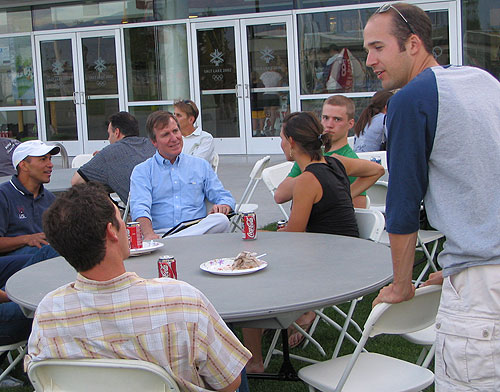
I spoke briefly with him, and he seems like a really nice guy. Most importantly he has a very clear understanding of the wildfires that threaten the house of US Speedskating, and he spoke frankly about them. I think he took the job knowing what was burning in the hills.
I just hope the winds don’t change, or if they do, he has firefighters on hand with enough water (read: money) to make a difference.
Filed under: from home




Sometimes, it takes more than money to douse a fire. Throwing money at a problem won’t necessarily fix it. I hope the new USS Board of Directors will be very clear about their philosophy and their goals. I hope they will follow a logical process for taking the federation in a new direction.
What criteria will they use to choose coaches? How do they plan to help their athletes win? How will they make deals that will be agreeable to both the athletes and the sponsors? How will they promote the sport?
If the core philosophy of USSPEEDSKATING has not changed, then the fires will continue to burn, no matter how much money is thrown at the federation.
nicely said eva,
as I was writing the post, in the interest of brevity, I took out a section wondering if the wildfires are from acts of nature, bad forestry planning, or deliberate arson..
but it’s certainly true that money is the ability to put ideas, philosophy, & fire prevention strategies into action, and money is in terribly short supply…
Hey Andrew,
I’ll be happy to fill in some details from my own warped perspective! I think that in the life cycle of a forest, fire serves a purpose and that is to clear out the dead wood to make room for new life. Sometimes, in order to clear out the dead wood, a spark is required. Maybe some people would consider such a person an arsonist, or a terrorist, or whatever…but the dead wood still has to go.
About money: As a skater, being short on funds was a major obstacle to me, so of course I understand how difficult it is to put an idea into motion without it! However, if I were a sponsor, I wouldn’t consider sponsoring a federation that has done some of the things USS has done to its athletes in recent years, unless I saw evidence of a serious commitment to change.
One thing I would like to see is for the National Team coaching selection committee to remove from their short list of candidates a person who is absolutely unable to work with women. They know exactly who I’m talking about without my having to name him, so they are aware of the problem. If they’re still considering him for a position, how much has really changed?
Hey, Eva, your comment about working with women really strikes home with me. I haven’t suffered much from it personally in the last couple of decades, but I’ve seen it. I’ve heard younger women say, in effect, that THEY’VE never had problems, all their lives they’ve been treated just on a par with guys, and all I can say is either they’ve been lucky or they’ve been blind. Yes, in life in general, and I’m sure in sport, it’s way better than it was in 1970. But it’s still far from right.
I recently quoted a friend who said that competitive shooting is a great way for women to meet men, because it not only weeds out the literal felons, it makes very clear who can and who can’t deal with a women who’s better than he is. (It’s also the only sport that I know of where women and men compete directly and there’s no apparent advantage for either.) Andrew, our host here, added that those who can’t deal with strong women are not men, but overgrown boys. Unfortunately, there are all too many of them.
One thing the US Forest Service has learned, the hard way, is that in some ecosystems, you can delay fires, but you can’t really prevent them, and delay makes them more severe. I fear that may be true of cultural fires as well.
I can’t help but put my two cents in. In veterinary medicine, there is an overwhelming swing towards female vets vastly outnumbering male vets, though in academia, men still vastly outnumber women. Makes for an interesting dynamic in vet school. As to why this is happening, there are many theories, which I won’t get into here.
I work in a veterinary practice with three other female veterinarians, and the only two male employees are technicians. I agree with Kate that sexism is subtle, and that working with a male vet would change my environment subtly. I’m benefitting from my current situation because neither I nor my clients have a male to defer to, which I think happens a lot without people realizing it. Yes, I am aware that I may unconsciously do that, and it’s good for me that the option isn’t there. Sexism is insidious!