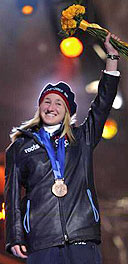
Zen 10 Questions: Jennifer Rodriguez

There are several kinds of reputation that athletes create. The first, of course, are their accomplishments on the field/court/ice. The second has everything to do with what kind of people they are & the personal interactions they have; so many well-known athletes pass the first test but fail miserably on the second.

However I can honestly say that even in the interpersonally carnivorous small fishbowl that the skating community can be, Jennifer Rodriguez & her husband, inline to ice pioneer KC Boutiette, enjoy a tremendous amount of respect from their peers. Time and time again I have heard stories of them helping out other skaters & giving of their time, knowledge & resources.

Here is a perfect example: when I asked Jen to be the next interviewee/victim of this blog, she was exhausted from a hard day of tempos, but was gracious & friendly as always!

Jen, given some of your biography & lifetime results it’s an honor to have you here on my humble blog, and I promise that I will attempt to ask questions that are completely unique, and nothing any Olympic press pool reporter will ever think to ask!

Fire away!

1. You won World Sprint Championships this last year, fantastic! But many athletes motivate themselves by being in the “constant underdog” mindset. Now that you are the current world sprint champ, does anything feel different in your psychological outlook & preparation for Torino?

Actually no. I still don’t consider myself the best. There are too many great girls out there pushing the envelope. The second you let your guard down, someone will be right there waiting to take your place. I’m just trying to push myself harder without going over the limit. I’m also focusing a lot on technique, trying to make it better and more efficient.

2. Does the media referring to you as J-Rod annoy you? I can honestly say I have never heard you referred to as J-Rod by any other skaters. My wife (Jessica Love) was sometimes called “J-Lo” by her classmates at Vet school, & she had mixed feelings about it.

Actually, there is one skater who calls me J-Rod and his name is Tucker Fredricks. He’s been calling me that for a while. At first I didn’t really like being referred to as J-Rod. I thought maybe people would think I was trying to copy A-Rod or JLO. Now, I’ve kind of gotten used to it.

3. You are in the tiny percentage of people who could actually experience a doper taking away something you have worked a lifetime towards. As I talked about in a previous post on this blog, the 2nd place finisher at world sprints behind you was caught doping by the ISU. What was your immediate reaction when you heard about that? Would your reaction be different if you had placed second to Kotiuga?

I was surprised. I’d like to think that speedskating is a clean sport. Unfortunately, that’s not always the case. It’s sad really. In a way it was pretty cool to be able to say I beat someone on drugs while I stayed clean. I’m not sure if my reaction would’ve been different had I finished second at Worlds. I would’ve probably been more upset.

4. Many articles refer to you & your connection to Miami, mostly in the context of how unusual it is for a speedskater to come from there. But no one seems to ask what are your favorite places, faces, & times of year in Miami? What makes it special to you?

My favorite place in Miami is my parent’s house. I also like to go to Coconut Grove, Bayside and Key Biscayne. My favorite faces are the Miami Heat, Florida Marlins and Miami Dolphins. My favorite time of year is spring time, because the humidity is not quite so high yet. Miami is special to me because of the mix of cultures it has. I love that. I love the different people, different foods and of course the different music.

5. Skating, when done correctly, looks effortless. The training and preparation for it is anything but effortless. What are the technical, physical, or lifestyle aspects to skating that you personally have to work really hard at?

I’m naturally not a very strong person, so I have to work real hard in the gym and during downtimes (ed note for non-skaters: downtime is when you practice the skating motion in running shoes off-ice, usually till the lactic acid comes out your ears).

I think I am strong for my size, but so many other girls are a lot stronger physically than I am. Because of this, I have to work extra hard on technique. The things I work hardest on are timing and early pressure.

6. I will not ask that annoying “So will you retire after the games?” question, instead, I will ask “what is wonderful about your life right now”, in the final few weeks before the world cup season begins.

Right now, my life is just about perfect. I am doing what I love best with my husband. I have a great coach, great teammates and great friends. I also have the love and full support of my family.

7. Does being an Athlete rep to the US Speedskating board give you a different perspective to the organization?

I think being an athlete rep has changed my perspective towards the organization. I used to think that USS had their best interests in mind rather than the athletes. Now, that I’m on the other side, I know that’s not true. USS may not always make the best decisions, but it’s not out of lack of effort. I truly feel they try to do what’s best for the athletes. I know it doesn’t always work that way, but I know they try.

8. Tell us something surprising about you or your life, something those of us who know you through skating would never have suspected:

I would like to be in the military. I’m too old to try now, but I would’ve welcomed the challenge.

9. When all the athletic hoopla is far past, and you just want to skate for pure pleasure, what first comes to mind? Quads & disco? Cruising a Dutch canal on classic Vikings? A hot day at South Beach on inlines? Or has skating been your job for so long, other things are in the “fun” category?

I will always love all aspects of skating, and I have a hard time imagining my life without it in one way or another. Of course there are other things would love to do that I have to wait to do until after my skating career is over, due to possible injuries. Things like, bungee jumping, motorbike riding, jet boating in Australia, swim with sharks (in a cage of course), or climbing Mt. Kilimanjaro (I don’t think that’s spelled right). I’ve never done that stuff, but I would love to try. I love adventure stuff.

10. No elite speedskater steps to the starting line alone, so many help along the way. Here is your chance to say thanks to those who have been there for you:

First and foremost I have to thank my parents. They have supported me from day one with everything I’ve wanted to do. Even when money was really tight, they found a way to make it possible for me to continue to skate.

Next, I have to thank KC for introducing me to the ice and being pretty much my crutch the entire way through my ice career. I would not be where I am today without him. I would also like to thank all the coaches I’ve had along the way and especially Tom Cushman, my current coach. He’s amazing. I need to thank my teammates for pushing me every day and of course our trainers who keep me injury free. I’m sure I’m forgetting a few people and I’m sorry if I missed you, but I want to say thanks anyways.

Haiku Speed Round

1. Is there anything unusual you pack when you embark on long world-cup trips?

Lots of tampons! I don’t like the ones they have overseas, so I have to bring my own.

2. You are described as a fan of basketball, snowboarding, jet skiing, cycling, & playing paintball. If you could wave a magic wand and become a pro in another sport, which one would you do?

Snowboarding

3. What is the most meaningful possession of yours from childhood that you still have?

My first pair of roller skates. They were the ones you wear with your sneakers. They were plastic Incredible Hulk skates.

4. Favorite Ann Rice novel?

The Vampire Lestat. I love vampire stuff.

5. What artist, living or dead, should be hired to design the USA swift skin graphics for the games.

Romero Britto. He is a South Florida artist. It may not be the most normal looking skinsuit, but it will sure be colorful.

6. A verbal expression or attitude that you picked up from KC that you use all the time?

If someone says to you “Go clean your room,” then you say, “No, YOU go clean your room.” That’s pretty much how we communicate.

7. What are the Weblinks to your sponsors?

8. Name a really expensive habit you wish you could afford?

Car collecting

9. I hear you are, like myself, one of the Mac faithful, what are you reading & writing this on?

Powerbook G4

10. When wandering past a Barnes & Noble endless magazine rack, what ones do you always flip through? What would you predict KC reaches for?

In Style magazine, Sports Illustrated, ESPN Mag, and Latina. KC would look at the VW magazine. He loves VW Bugs (the old ones).

all photos in this interview are from Q-Sports

Zen 10 questions: Joey Cheek

On February 16th of 2002, I was in a Lake Placid hotel room, watching Canadian TV coverage of US speedskater Joey Cheek winning a bronze medal in the olympic 1000m. I was on my second weekend ever at a long track, skating f-ugly in the blizzards of Placid, and understanding what I was seeing on TV from a whole new perspective. I never suspected that 4 years later, I would be walking into the same oval I had been watching on TV, and my friend Joey mentioned to me that he had followed a link from Eva’s blog, and that he had enjoyed reading a good chunk of mine. I immediately invited him to be the next Zen 10 interviewee/victim.

Joey, given some of your accomplishments, it’s an honor to have you here on my humble blog, and I promise that I will attempt to ask questions that are completely unique, and nothing any Olympic press pool reporter will ever think to ask!

1. I remember last October, when you and the US national sprint team were training in Milwaukee, I watched you do some very hard solo efforts at top speed, 800m/1200m/1600m I think. If I recall, you puked several times that day from the effort. Later that week at the US single distance championships, you set the Pettit rink record in the 1000m. In my twisted associative mind, you earned that rink record training to those painful limits the week before. Shatter my illusion or confirm it, was I witnessing just a really bad day? Or was something special happening?

HAHAHA - yep, these questions are going to be fun. For whatever reason of biology, I have always been a puker. Those super-high lactate days (in the 18-20 mm/l or whatever the unit is) do a number on my stomach. I like to think that they are part of the reason I do well at the 1000m, 1500m. Otherwise I have really wasted a lot of perfectly good food. I think that it is better to hurt in practice, so you feel good during races.

2. You are consistently in the top 15 sprinters in the world, and in the biggest meets, you are a frequently resident on the podium. From your perspective as one of the truly fast what are the factors that sorts out who is 1st, 3rd, 8th, 12th? Everyone is talented, everyone tries really hard, what creates those tiny differences?

Hmmmm, I will try and keep it short. I am not one of those that pretends that good ‘ole elbow grease and hard work will make up for bad genetics. I believe that unbelievable talent is actually better to have than just working hard. That being said, speedskating is a very technical sport. If you have somebody with, say, above average physical ability and they spent their time learning how to really skate well, they will be able to beat a lot of the top skaters. But someone like Jeremy Wotherspoon. More talented than almost all, and a very good technical skater - well, his record speaks for itself. Attention to detail, perfecting the little things, those tend to separate the rest of the herd.

3. You have been an elite athlete most of your life, as a young inliner you went to inline world championships twice, and you have competed internationally on ice since 1997, Very few people have any clue what its like to live the kind of life that you do. How do you describe the pressures you face at “the office”

For starters, my job is, in a lot of ways, easier than many people imagine. Yes, we still have 7 hours days occasionally, and anyone who knows me will tell you that I hate being on a bike for more than 15 min, but I do what I love. I have a lot of down time, and every four years or so people will pay me a ridiculous amount of money, just to talk about myself. What I think makes it difficult though is the fact that of every one of us doing this only one wins. We wake up and for four years at a time, we train to be the best ever for 30 or 60 sec. Don’t fuck up - just win. Most people have a hard time putting in so much time for something, that almost no one will accomplish. But I still love it.

4. Skating, when done correctly, looks effortless. The training and preparation for it is anything but effortless. What are the technical, physical, or lifestyle aspects to skating that you personally have to work really hard at?

I have found that I do the same few things technically incorrect over and over. The secret for me has been to drive in, day after day, the corrections to those problems. Then when I race to not try and go fast, but to simply let my body do what I have drilled over and over and over. Zen-like huh?

5. You have skated the world cup circuit for quite a few years. Aside of the folks on the US team, who are the really nice folks on the international circuit?

Of course my teammates - Nick, Tucker, Fitz, Needham, Tim. Those guys are absolutely my best friends in the entire world. And honestly, most people on the circuit are pretty cool. I am good friends with Erben and Mark Tuitert. Oh yeah, all the Japanese are awesome! Especially the Sankyo speedskating team.

6. Tell us something surprising about you or your life that those of us who know you through skating would never have suspected:

Well, none of my friends would be surprised by this, but I was a huge geek in middle school and most of high school. I would probably have been chosen in school as least likely to participate in a sporting event.

7. In your bio on the US speedskating website, it mentions that you build and shoot potato guns, I have seen people with things that look like homemade PVC bazookas launch potatoes huge distances, how big is your cannon and what is your farthest shot so far?

Haha, it is about 4 and a half feet and I can shoot about 275 yards.

8. You mention in your bio that you want to go to law school, and I have heard rumors you have been spotted with studying materials on world cup trips! Is it an advantage or disadvantage to have a good mind in a sport like this?

Ahhhh, I don’t know, one of the hardest things for me to do is not think too much. I can’t say if it is an an advantage or not to be book smart, but every great athlete I have met has been a genius about their sport and about psychology. Maybe not in the traditional sense, but still a genius in some regard.

9. No elite speedskater steps to the starting line alone, so many help along the way. Here is your chance to say thanks to those who have been there for you:

First: Mom and Dad. They are always first. Then my teammates and coaches. Finn Halverson from Norway changed my life. Finally Eleanor, my girlfriend. Probably the most recent addition, But she has helped and added things to my life I could never have imagined.

10. Haiku Speed Round
1. Favorite city on the world cup circuit to find really good food?

Anywhere in Italy

2. Your dream house: where is it and what does it look like?

On cliffs overlooking the beach - Cape Cod style

3. You spent the off-season this year in France, give me 3 words to describe France.

Like America More

4. Do you see yourself living in North Carolina again? I used to date a woman from Greensboro, it’s a nice place.

Thats where I grew up, I love it

5. I hear you play guitar, If you could borrow for 24 hours the skill of any musician who ever lived, who would it be?

Eddie Vedder

6. Movie you never get tired of seeing?

Dazed and Confused

7. What was the best Halloween costume you ever had as a kid?

A robot!!

8. Name a really expensive habit you wish you could afford?

Collecting Ferraris

9. Are you tempted at all to own a copy of “The Cheek Family Chronicles“? After all, they mention you as one of the 9 most notable “Cheeks” of all time! (besides it’s only a 1,104 page, 8 lb book!)

Hahah!! Shouldn’t I get a complimentary copy?

10. When wandering past a Barnes & Noble endless magazine rack, what ones do you reach for and flip through?

Always the Economist, sometimes Playboy.

Thanks for your time Joey, its always a pleasure talking with you, I hope that when readers of this blog see you on TV during the upcoming winter Olympic games, they will have a much clearer picture of the interesting mind under that skinsuit hood!

Zen 10 Questions: Dave Tamburrino

Anyone who has ever skated Long Track at the Pettit center in Milwaukee recognizes 2 time Olympian Dave Tamburrino’s intense face at the end of the straightaway. He is usually so completely concentrated & involved with the 20+ skaters he currently coaches it’s hard to grab a word with him. But if you catch him off the ice, he is warm and quite funny, with an offbeat sense of things. I though these qualities made him the perfect candidate/victim for a ZEN 10 interview. I have so often been tempted to ask Dave what really goes on in that brain of his, now here is my chance!

1. I asked Casey Fitzrandolph what was the craziest thing he ever saw on skates. This is the story he told me:

“We were training in Inzell, Germany. On that track, the Zamboni’s enter in the corner. One came onto the ice just as Dave Tamburrino came around the corner at top speed doing a flying 400m. I thought Dave was going to die for sure, but he leaned completely over, put his hand on the ice, and did a perfect graceful short track pivot around the Zamboni! On his long track skates!”

Do you remember this? And do you have your own “Craziest thing on skates” memory to add?

Come to think of it, I do remember that - about 8 years ago or so. Which is surprising, because I couldn’t tell you what I wore to work on Friday. Craziest thing I’ve ever seen on skates: Johan Koss beating Frank Dittrich by over one lap during Koss’ 10,000 meter gold medal performance in 1994.

2. You went to 2 Olympic games, 1994 and 1998. What moment from the Olympics comes first into your mind when you think to your experiences there? I have heard from several Olympic skaters that your first trip to the games has a vastly different feeling than subsequent ones, was this true for you?

Hearing 75,000 fans go crazy for the USA during the 1994 Opening Ceremonies gave me goosebumps, and thinking about it today still gets me pumped. My first Olympic experience in 1994 was like going to Disney World for the first time. The second time in 1998 was like punching a time clock before starting work.

3. Do you have a couple of core principles you follow as you write the training programs for your skaters?

Each morning in Africa a lion wakes up knowing it must be faster than the slowest gazelle if it plans to survive. Each morning in Africa a gazelle wakes up knowing it must run faster than the fastest lion if it is to survive. It doesn’t matter if you are a lion or gazelle, when the sun comes up… You’d better be running.

4. What are the major mistakes athletes who train on their own, withut the benefit of a coach, make?

Don’t know. If I’m not coaching an athlete, how am I supposed to know what mistakes the athlete is making?

5. Do you miss skating full time? When you arrive at the Pettit Center for those dawn time trials, does the competitive urge flash within you? Or does coaching/your sweet job with the milwaulkee brewers fill that need?

The only thing I miss about skating is knowing that I’ll never have an opportunity to make good on the mistakes I made during my career. Racing and training I made some great decisions, and a lot of bad decisions. What I can do is take the lessons I’ve learned and the knowlege I’ve picked up along the way and use it to help future generations become their best. Today, I get more satisfaction from knowing my work could result in an Olympic medal for one of my athletes than if I were to go out and try and win one for myself. Been there, had my shot, done that.

6. Tell us something surprising about you or your life, that those of us might have met you through skating would never have suspected:

I’m ranked 23rd on the DezClan Half Life 2 server out of over 500 people. I plan on cracking the Top 10 in the next couple months.

7. What was your happiest moment as a skater? Your win at US nationals in 1988? 5th in world allarounds in 1995? Or is it in some race in a blizzard long ago that everyone else has forgotten but you?

Happiest moment as a skater: Winning my third consecutive National Short Track Championship in 1989.

8. What has been your most satisfying moment as a coach?

Tallying up all of my athletes personal bests at the end of the 2004/2005 season, and seeing tangible results on paper that everyone in the group has gotten faster.”

9. Who are some of the good folks of this sport? The smart, funny, good hearted fellas that you still really enjoy sharing dinner table conversation with?

Good folks: The underappreciated officials who make the weekend time trials at the Pettit possible. Thank you, your work is not un-noticed.

10. Speed Haiku Round
1. Best car on the road other than the mini-cooper youdrive

BMW M3 w/ Competition Package.

2. Do you think doping is a problem in speedskating today at the elite level?

Doping is an issue that needs to be addressed in all sports.

3. What coach did you have when you were competing that really influenced your own coaching style the most?

I’ve taken the best from Pat Maxwell, Diane Holum, Mike Crowe and Gerard Kemkers, and have mixed in a few of my own ideas. And, it is working.

4. Who do you think would be a better speedskating coach, archetypally speaking; Yoda or Darth Vader? and why? (I played hockey for both in my youth, and I was a better player for Vader).

Best coach: Darth Yoda.

5. What movie do you never tire of seeing?

Miracle.

6. Some theorize that our personalities are formed by our defeats & failures more than by our successes. Do you agree or disagree?

Don’t know, don’t care. Skate fast and make me proud to say that I am your coach.

7. Will Lance win another Tour De France?

Ask Lance.

8. Born in Saratoga Springs, but Wisconsite for a long time now, are you a loyal Packers fan?

Yes. I’ve been to Lambeau 3 times, and saw the Pack win each time.

9. We are close to the same age, will I ever get the memorable pleasure of going blade to blade with you in a masters race?

Nope.

10. Is there any truth to the rumor that you once lost a bet involving Gunda Neiman’s 5k time vs your own 5k time? And that there was nudity involved for loser of said bet?

I’d never offer up the chance to be seen naked outside in the middle of winter.

Thanks Dave! I feel like Darth Yoda has finally spoken, and the skating world is richer for it.

ZEN 10 Questions: Jim Cornell interview

I first met Jim Cornell in Lake Placid some years ago at the Connecticut speed skating association Christmas Camp. We quickly became friends (skating in screaming blizzards can accelerate the process of getting to know someone), and he is someone whom I have come to respect deeply, as a skater, as a coach with the Rochester speedskating team, and as an allaround excellent fellow.

Jim recently was honored as US Speedskating’s Volunteer Coach of the Year, he also had an article published about him in the Rochester Democrat & Chronicle. I am going to be adding short and sweet interviews to this blog, I call them “Zen 10 questions” and Jim seemed an ideal choice for the first one!

Hello Jim!

It is an honor to be interviewed on the Andrew Love blog. We have had many interesting speedskating related conversations in Lake Placid.

1. What world class speed skater would you someday like to have dinner with? What kind of questions would you ask them?

Eric Heiden. How did you get started in speedskating? What motivated you to endure the rigors of high intensity training? What was it like traveling the world speedskating at such a young age?

2. Your skaters talk of “The Plan” that you have spent over 200 hours developing, I have seen it, in its phone-book sized binder, and it’s more complicated & detailed than some national team annual plans I have seen. Can you describe it for all those in internet-land?

“The Plan” is a year long periodization road map. It consists of a few interactive spreadsheets (described below) that can be customized on an individualized basis.

1. The yearly planner – the big picture of competitions, training sessions, workloads, year end summaries and graphs which are used to view all the periodization cycle parameters.

2. Weekly workouts - detail customizable workouts. These are sent out in monthly blocks.

3. Personal summary page – charting of personal performance, physical and emotional ratings, heart rate, body weight and body fat. This let you see overtraining and under training trends.

3. Describe some of the improvements skaters following “the Plan” have had? Are you modifying it this year?:

This year we had great success with the plan and it is the first year we used it. Here are the highlights:

1. Marty Medina national short track gold medalist masters 30-39.

2. Craig Pielechowski national short track gold medalist masters 60-69.

3. Mike Burdekin national short track gold medalist juvenile.

4. Many personal bests. Personally, I took 3 seconds off of both my 500 short track and long track times. In my 1500M long track I took 10 seconds off.

There were several changes this year:

1. I created a training diary that has emotional and physical rating scales, meal entry and workout entry. At the USS spring board meeting Jen Rodriguez saw it on a table and liked it, so I gave her a copy to use. Also, the short track team in Marquett are receiving copies.

2. More performance testing. Our cycle is 4 weeks. Week 1 is recovery (easy) Week 4 is the toughest. It is in week 4 that our workouts become tests. We do strength, speed, power, agility, vo2max, aerobic and anaerobic tests over the course of the week. The test results are recorded and tracked for each individual.

4. Do you have anything readers can download to read more about the plan?

Every year our team gets together for a presentation which covers the upcoming year of training. It covers what is periodization training, what types of training sessions we do. Everything from training, recovery to nutrition is covered. This year’s presentation can be downloaded by your readers. (the 8.5 mb powerpoint will be downloaded directly by clicking here).

5. Most coaches hung up their own blades long ago. You still compete, and compete very well! You won the Jack Shea Sprints in Lake Placid as well as taking 3rd overall in the Season ice marathon series Is it hard to skate as well as coach? Or are there benefits? (the pic is Jim leading the pack at US ice Marathon National champs, 50k is a looooong race).

It is hard to skate and coach at the same time. I am lucky that Rochester has many coaches so I do not have to do keep an eye on everyone all the time. There are benefits to coaching. The process of breaking down the speedskating technique into small parts for teaching purposes has helped me understand technique more.

6. You were named US Speedskating’s Volunteer Coach of the Year this year. Where were you when you found out? What was your immediate reaction?

I was at work when I got an email from USS congratulating me on being nominated volunteer coach of the year. They needed a picture of me ASAP. My immediate reaction was, “Is this some sort of a joke?” I did not tell anybody until it was put on the USS website. Then I knew it was for real.

7. What has been your happiest moment, as a coach? How about as a skater?

As a coach, wining the volunteer coach of the year was awesome.

As a skater, I don’t have a happiest moment, but feeling the speed coming out of a corner always makes me happy.

8. Paul Marchese once said to me “dryland is the brussel sprouts of your training diet”. Do you agree? What do you think he means?

I totally agree! I think he means that you may not like it, but it is good for you.

Another dryland quote I like is from Pat Maxwell. He said “A breakthrough season starts with a breakthrough summer.”

9. Tell us something surprising about you or your life, that those of us who might have met you through skating would never have suspected:

I received my pilots license at the age of sixteen and retired from flying at the age of 22.

10. Haiku Round Speed Questions

1. Awesome training book?

Periodization of strength by Tudor Bompa

2. Best Coach you know?

Sue Ellis

3. Ideal post-marathon meal?

Lasagna

4. What movie do you never tire of seeing?

Stripes

5. What do you skate on?

Viking for long track and SS for short

6. Really expensive habit you wish you could afford?

world traveling 10 months a year

7. Biggest influence on your life?

Speedskating and all those involved

8. 2 Internet sites you visit all the time?

rochesterspeedskating.org & CNN.com

9. Do you think America fundamentally divided between “red states” & “blue states”?

yes

10. How about a quote you find motivating?

Whether you think you can or can’t, you’re right.

Thanks Jim! it was great chatting and I look forward to crossing paths with you this year!